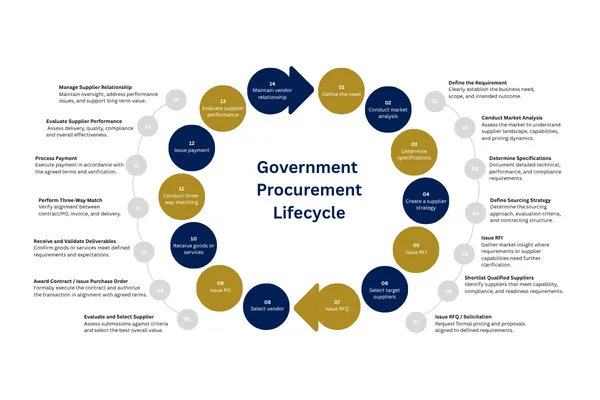
The Government Contract Lifecycle: From Acquisition Planning to Contract Award
Introduction:
Government contracting follows a structured process designed to ensure transparency, competition, and accountability in the use of public funds. While many organizations focus primarily on responding to solicitations, government contracts move through several stages before reaching the proposal evaluation and award phase.
This structured process is often referred to as the government contract lifecycle. Each stage of the lifecycle plays a role in shaping how procurement decisions are made and how contract opportunities are developed.
Understanding the stages of the contract lifecycle can help organizations better interpret procurement environments and gain insight into how government acquisition processes operate.

Stage 1: Market Research and Requirement Identification
The government contract lifecycle typically begins when an agency identifies a requirement that must be fulfilled through external procurement.
During this stage, agencies conduct market research to determine whether capable vendors exist within the marketplace and to evaluate potential solutions.
Common market research tools include:
• Requests for information
• Sources sought notices
• Industry consultations
• Vendor capability assessments
Market research helps agencies understand the vendor landscape and determine the most appropriate acquisition approach.
For organizations interested in government contracting, this stage often provides early indicators of upcoming opportunities.
Stage 2: Acquisition Planning and Strategy Development
Once the requirement has been identified, acquisition professionals develop the procurement strategy that will guide the contracting process.
This strategy outlines key elements of the procurement, including:
• Contract type
• Competition approach
• Evaluation criteria
• Contract structure
Acquisition planning ensures that the procurement process aligns with regulatory requirements and agency mission objectives.
At this stage, procurement teams collaborate with program offices and legal advisors to determine how the contract will be structured.
These strategic decisions influence how organizations will later compete for the opportunity.
Stage 3: Solicitation Development
Following acquisition planning, the agency prepares the formal solicitation.
The solicitation communicates the government’s requirements and provides instructions for vendors interested in submitting proposals.
Solicitations typically include:
• Scope of work
• Proposal submission instructions
• Evaluation criteria
• Contract terms and conditions
This stage represents the most visible portion of the procurement process, as solicitations are typically posted on procurement platforms for vendors to review.
Organizations that wish to compete for the contract must carefully analyze the solicitation and ensure that their proposals align with the government’s stated requirements.
Stage 4: Proposal Evaluation
Once proposals have been submitted, the agency conducts an evaluation process to determine which offer best meets the government’s requirements.
Evaluation teams assess proposals based on the criteria outlined in the solicitation.
These criteria may include:
• Technical capability
• Past performance
• Pricing
• Compliance with proposal instructions
The evaluation process is designed to ensure fairness and transparency while identifying the proposal that represents the best value to the government.

Stage 5: Contract Award and Administration
After evaluations are completed, the agency selects the successful vendor and formally awards the contract.
However, the procurement process does not end with contract award.
Contract administration becomes the next critical stage, ensuring that the contractor fulfills the obligations outlined in the agreement.
Contract administration may involve:
• performance monitoring
• compliance oversight
• project management coordination
• contract modifications
This stage ensures that government programs receive the services or products necessary to achieve mission objectives..
When Organizations May Need Procurement Advisory Support
Organizations navigating the government contract lifecycle may encounter challenges at various stages of the procurement process.
Advisory support may be helpful when organizations need insight into:
• procurement structures and acquisition strategies
• contract readiness and compliance expectations
• interpreting solicitation requirements
• understanding how evaluation processes work
Developing a clear understanding of the contract lifecycle can help organizations approach government contracting environments with greater awareness and preparation.
Closing
The government contract lifecycle reflects the structured nature of public-sector procurement. From early market research through acquisition planning and contract administration, each stage plays a role in shaping how government contracting opportunities are developed and executed.
Organizations that understand the broader procurement lifecycle gain valuable insight into how acquisition decisions are made and how contract opportunities evolve within government procurement environments.
Emanite Enterprise Solutions provides procurement advisory services to organizations seeking greater clarity around government contracting processes and acquisition strategy environments.
Procurement Advisory Support
Emanite Enterprise Solutions provides procurement advisory services that help organizations navigate federal acquisition environments, strengthen procurement strategy, and better understand government procurement processes.
Organizations seeking greater insight into procurement strategy or federal contracting environments may contact Emanite Enterprise Solutions to discuss their procurement objectives.